
Why Does Your Body Need Protein?
Protein provides amino acids that the body uses to build, maintain, and repair tissues. It contributes to muscle structure, skin, enzymes, and many other substances involved in normal body functions. Because some amino acids cannot be produced by the body in sufficient amounts, they must come from food.
However, eating more protein does not automatically produce more muscle. Muscle development also depends on resistance exercise, sufficient energy, recovery, and the overall quality of the diet. Protein intake is one part of nutrition rather than an independent measure of fitness or health.
Understand the Reference Amount Per Kilogram
The U.S. recommended dietary allowance (RDA) for protein for healthy adults is 0.8 grams per kilogram of body weight per day. This provides a general U.S. reference for healthy adults, not a universal target for every person or a treatment recommendation. For example, multiplying body weight by 0.8 gives a straightforward reference calculation.
The NIH Office of Dietary Supplements describes protein intakes of approximately 1.2–2.0 g/kg/day in the context of athletes and their training demands. This range should not be applied automatically to everyone who exercises. Training characteristics, nutritional intake, and individual circumstances matter when interpreting higher estimates.
Understand What a Protein Calculator Estimates
A basic calculation multiplies body weight in kilograms by a selected protein factor. More elaborate calculators may also use activity levels and dietary goals to adjust the result. These additional inputs introduce assumptions rather than directly measuring how much protein your body requires.
The Util Monster Daily Protein Calculator uses its own activity and goal multipliers, applies a calculation range, and presents an estimated daily amount with a suggested three-meal distribution. This is a calculator-specific model, not the NIH recommended dietary allowance formula or an individualized clinical assessment. Changing an activity setting does not automatically establish an official athletic protein requirement.
Check Protein Amounts on Food Labels
A calculated daily amount becomes more useful when compared with the foods you actually eat. Nutrition labels usually report protein per serving, so check the stated serving size and the number of servings you consume. A product containing 12 grams of protein per serving provides a different total when you eat one serving versus one and a half servings.
Also distinguish grams of protein from grams of food. A 100-gram portion of food does not necessarily contain 100 grams of protein. Preparation and moisture content matter too: dried and cooked beans can have substantially different protein values per 100 grams. Use a nutrition database or the product's own label with the correct food and preparation basis.
Consider Meal Distribution Without Chasing a Deadline
Meeting an appropriate overall daily intake is more important than following an exact protein-eating clock. Including protein-containing foods across regular meals can make it easier to account for intake without concentrating everything in one meal.
Exercise nutrition guidance sometimes discusses protein consumption after training and at intervals throughout the day. These approaches describe possible strategies for supporting training adaptation, not a universal deadline. Missing a particular post-exercise window does not mean that a workout has become ineffective. Choose meal arrangements that fit your normal eating pattern.
Food Choices and Individual Health Considerations
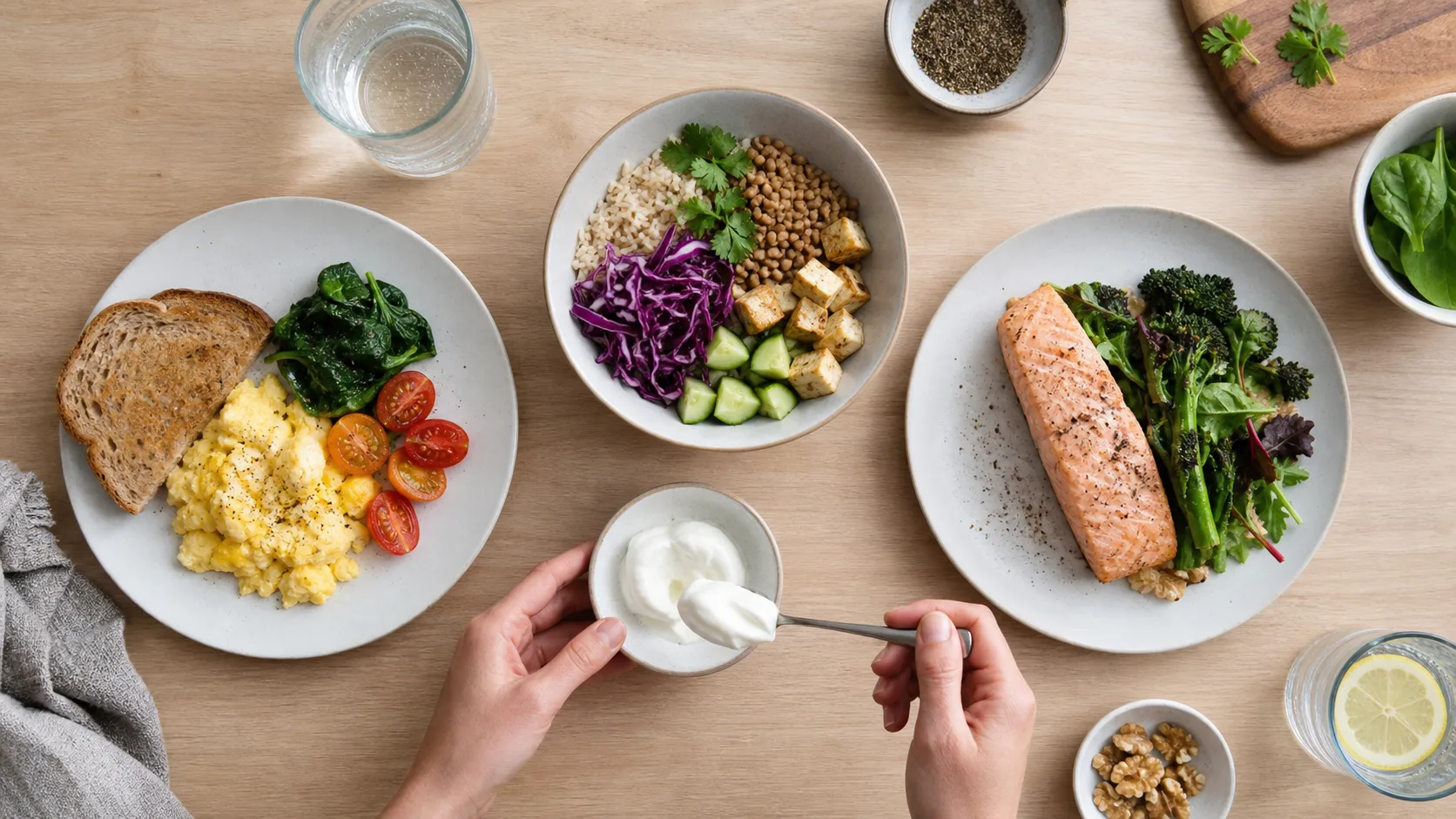
Protein comes from many foods, including fish, meat, eggs, dairy products, tofu, beans, and other legumes. Different sources also provide different combinations of fats, carbohydrates, vitamins, and minerals. Considering the whole meal helps avoid treating protein quantity as the only measure of dietary quality.
Supplements can provide convenience, but they are not automatically necessary. People with kidney or liver conditions, those advised to restrict protein, and people with other relevant medical needs should obtain individual guidance before changing their intake. Adult calculator estimates should not be treated as targets for children or as pregnancy-specific recommendations.
Example 1: Calculating an Adult Reference Amount
A hypothetical healthy adult weighs 70 kg. Use the healthy-adult protein RDA reference of 0.8 g/kg/day solely to demonstrate the arithmetic.
70 kg × 0.8 g/kg = 56 g/day
The calculated reference amount is 56 grams of protein per day. This is an educational reference calculation, not an individualized target or a recommendation for every adult.
Example 2: Calculating Protein From a Food Label
An illustrative, invented nutrition label states that one serving contains 12 grams of protein. The hypothetical portion consumed is 1.5 servings.
12 g per serving × 1.5 servings = 18 g
The portion provides 18 grams of protein. This example demonstrates label arithmetic and does not describe an actual product.