
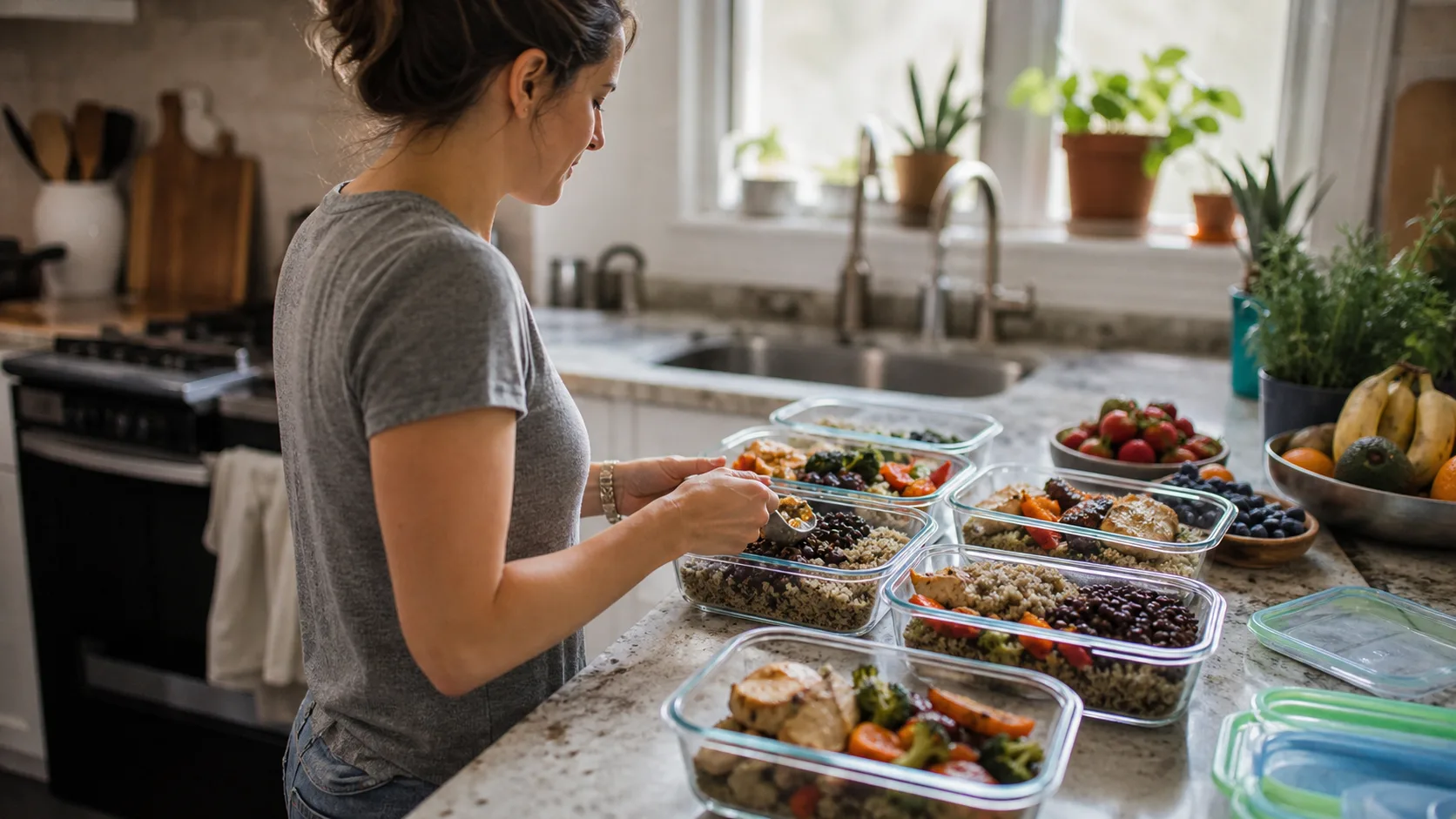
Choose a Manageable Batch Before You Start
Begin with one or two familiar meals that are difficult to prepare on busy days. Consider how many portions you will actually use, how much time cooking requires, and how much refrigerator and freezer space is available. Expand the batch only when the routine works.
Choose Ingredients Around Your Needs
Combine grains, vegetables, fruit, legumes, eggs, fish, or other protein foods according to your preferences and portion needs. Check ingredient labels when allergies or intolerances matter. A particular calorie target, ingredient, or menu is not automatically appropriate for everyone.
Prepare Ingredients and Cook Safely
Clean preparation surfaces and utensils, and keep raw ingredients separate from cooked and ready-to-eat foods. Follow food-specific cooking temperatures, checking internal temperatures with a food thermometer where appropriate. Do not assume that increasing recipe quantities means cooking time can be increased proportionally.
Cool and Store Prepared Food Promptly
Refrigerate perishables promptly after cooking or removal from heat, within two hours, or within one hour when temperatures exceed 90°F (about 32°C). Divide food into shallow containers rather than leaving a large pot to cool on the counter. Keep the refrigerator at 40°F (about 4°C) or below. Many cooked meat and poultry leftovers, soups, and stews have refrigerated storage guidance of three to four days, but limits vary by food. Freeze portions intended for later use promptly.
Thaw and Reheat Food Properly
Never thaw perishable food on the counter. Follow appropriate thawing and handling instructions, keeping perishable food under suitable temperature conditions. Reheat leftovers to an internal temperature of 165°F (74°C), checking with a food thermometer. Stir or rotate microwave-heated food to address uneven heating. Freezing or reheating cannot reverse unsafe storage, and smell or appearance alone cannot establish safety.
Review Each Batch and Improve the Next One
Label containers with preparation dates and contents. Record which portions were used, which remained, how well meals reheated, and how long preparation took. Use these observations to adjust your next shopping list and batch size while continuing to follow food-specific storage limits.
Scaling One Ingredient for a Smaller Batch
Hypothetical recipe containing 900 g of one ingredient for six portions. You want to prepare four portions and are scaling the ingredient quantity proportionally.
Portion factor = 4 / 6 = 2/3. Required ingredient = 900 g × 2/3 = 600 g.
The proportionally scaled recipe uses 600 g of that ingredient. This calculation does not establish nutritional adequacy or food safety, and cooking time must not be scaled linearly using the same factor.
Dividing a Batch Between Refrigeration and Freezing
Hypothetical batch of six cooked portions. Three are planned for the near term and three are intended for later use.
Total portions = 6. Refrigerated portions = 3. Portions for prompt freezing = 6 - 3 = 3.
Plan to refrigerate three portions and promptly freeze three portions. Apply the appropriate storage limits and handling instructions for each food. This is not permission to keep all six portions refrigerated for six days.