
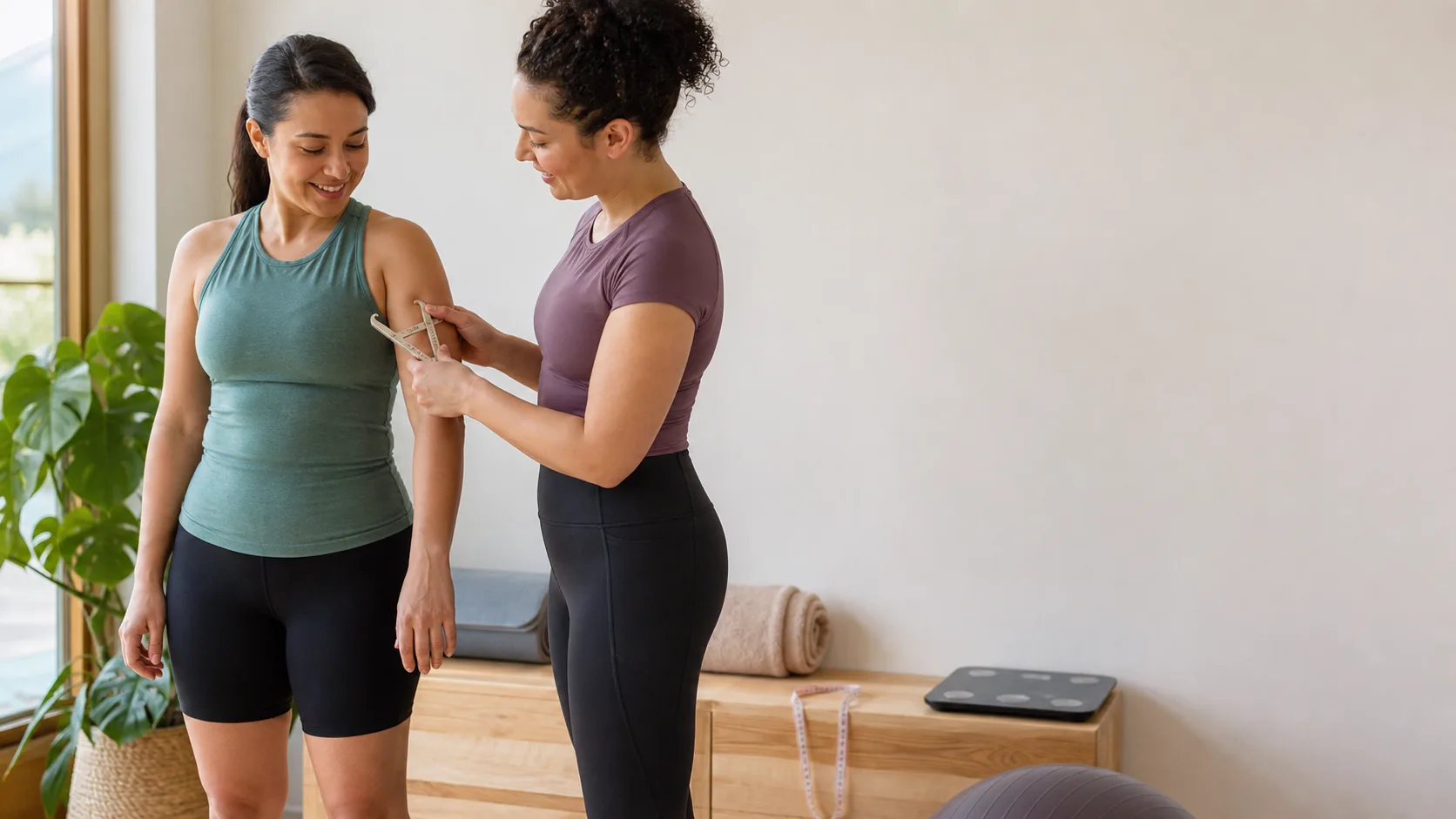
What Body Fat Percentage Means
Body fat percentage is the proportion of total body weight represented by fat mass. The calculation divides fat mass by total body weight and multiplies the result by 100. For example, an estimated fat mass of 14 kg in someone weighing 70 kg corresponds to an estimated body fat percentage of 20%.
Fat-free mass is the remaining weight after estimated fat mass is subtracted from total body weight. It includes muscle, bones, organs, water, and other non-fat tissues. It should not be treated as a measurement of muscle mass alone.
Unlike BMI, which uses only height and weight, body fat percentage attempts to describe body composition. However, the result depends on how fat mass is estimated and should not be interpreted as a standalone diagnosis or complete health assessment.
How Body Fat Measurement Methods Differ
Body composition can be assessed using several methods, including bioelectrical impedance analysis (BIA), dual-energy X-ray absorptiometry (DXA), and skinfold measurements. Each method uses different measurement principles and assumptions, so results from different methods are not automatically interchangeable.
Many home body composition scales use BIA. These devices measure electrical impedance and use predictive equations to estimate body water and other body composition values. A displayed body fat percentage is therefore an estimate produced by a particular device and model, not a direct weighing of body fat.
DXA provides another method of assessing body composition through measurements of tissue attenuation. Research comparing a particular multi-frequency BIA device with DXA in the adult sample studied illustrates why the performance of one device in one sample should not be generalized to every device or population.
Why Hydration and Measurement Conditions Matter
BIA relies on electrical measurements influenced by the body's water distribution. Hydration status and other measurement conditions can therefore affect the estimates produced by a device. Recent research examining passive dehydration in healthy, physically active men found changes in BIA-derived body composition estimates under the study conditions.
This does not mean every difference between readings is an error. Some changes may reflect real physiological variation, while others may be influenced by measurement conditions or model assumptions. The size and direction of the effect can depend on the device, population, and circumstances.
A useful interpretation therefore considers how and when a measurement was taken. A reading obtained under different conditions should not automatically be compared with an earlier result as though both represented identical measurement circumstances.
How to Compare Body Fat Estimates Over Time
When following body composition estimates, use the same measurement method and device whenever possible. Try to keep the measurement conditions similar, including the time of day, hydration circumstances, recent activity, and device positioning where applicable. Follow the manufacturer's measurement instructions rather than creating an unverified testing protocol.
Looking at repeated results can provide more context than focusing on a single reading. However, a series of estimates does not guarantee that small changes represent actual changes in fat tissue. Differences between devices or measurement methods introduce additional uncertainty.
Weight and waist measurements may provide complementary information, but they also describe different aspects of the body. Recording several indicators can help prevent one changing number from dominating your interpretation.
Why There Is No Universal Ideal Body Fat Percentage
Body fat estimates depend on factors including age, sex, population, measurement method, and the assumptions used by a device. Athletic reference ranges are designed for particular contexts and should not automatically be treated as general health standards.
A single percentage cannot establish whether someone has a medical condition, whether a particular weight is appropriate, or whether an individual needs to lose fat. The same numerical estimate may also have different implications depending on a person's broader circumstances.
Fat-free mass should be interpreted carefully as well. It includes several types of non-fat tissue, not just skeletal muscle. A change in estimated fat-free mass therefore does not independently demonstrate an equivalent change in muscle tissue.
When Professional Interpretation Is More Appropriate
If body composition results are being used as part of a medical assessment, the measurement method and its limitations should be considered by a qualified professional. A home calculator or consumer device cannot establish a diagnosis or determine the cause of a change in body composition.
Pregnancy, breastfeeding, adolescence, medical conditions, and a history of disordered eating can make general body composition targets particularly inappropriate. In these circumstances, an individualized discussion with an appropriate healthcare professional is more useful than applying a generic percentage range.
The practical value of a body fat estimate is limited to the question it can reasonably address. Understanding the calculation and the method behind it is more important than treating a displayed percentage as a perfectly precise description of the body.
Example: Calculating Estimated Fat Mass
Hypothetical adult weighing 70 kg with an estimated body fat percentage of 20%.
Estimated fat mass = 70 × 0.20 = 14 kg. Estimated fat-free mass = 70 − 14 = 56 kg.
Estimated fat mass: 14 kg. Estimated fat-free mass: 56 kg. The calculation illustrates the relationship between the percentage and total weight; neither value is a direct measurement of tissue.
Example: Comparing Two Estimated Readings
Hypothetical adult weighing 70 kg. First estimated reading is 20%, followed by a second reading of 22%. The same total body weight is used for both arithmetic examples.
First estimate: 70 × 0.20 = 14 kg fat. Second estimate: 70 × 0.22 = 15.4 kg fat. Difference: 15.4 − 14 = 1.4 kg. Corresponding estimated fat-free mass changes from 56 kg to 54.6 kg.
The estimated fat-mass difference is 1.4 kg. This arithmetic comparison does not establish that 1.4 kg of actual fat tissue was gained or explain why the readings differ.